
Every home should have a lemon tree. But what if you’re a long-term renter, your gardening space is barely big enough for a clothesline, or you need to stick to a tight budget?
Gardening in pots, maximising vertical space by espaliering plants, and keeping an eye out for ‘useful things’ is the answer!
A garden in pots also means there’s no need to get permission from your landlord if you want to plant and grow stuff, and when the time comes to move there’s the added bonus of being able to take your garden with you!
How It All Started
When I moved into my unit nearly two decades ago, I wasn’t expecting to stay as long as I have. Right from the start, I wanted to make my tiny courtyard feel homely and settled. I needed something to screen off the gap in the side fence leading to the bin area, and I wanted an evergreen plant to provide height and make the space feel bigger, all while thriving in a pot.
I knew a lemon tree would be perfect for the job, but my budget was very limited. So being a keen rescuer of plants, I started keeping an eye on the markdown sections at local nurseries.
I was specifically after a Eureka lemon for its tangy juice and very lemony zest. So it was with some excitement that one day I did indeed find a lonely, yellow-leafed, pot-bound specimen that I could rescue. Once repotted into a large container, it grew tall and healthy, successfully screening the bins and adding the height I wanted–despite the tendency to fall over when it was very windy and heavy with fruit!
After fifteen years of regular repotting and hard pruning to rejuvenate it, keep it productive and keep the citrus galls at bay, my faithful old lemon tree became woody, misshapen and virtually leafless. It was clearly at the end of its viable potted lifespan, so I began to work on a succession plan. A bushy, native lemon myrtle stepped in to screen the bins, which left me without a lemon tree and seemingly out of sunny spots in my courtyard.
.jpg)
The Spark Of An Idea
A few months later, on a Saturday afternoon cruise of the nurseries and garden centres in my local area, I spotted a display of beautiful espaliered citrus trees for sale. They were quite expensive because of the amount of work that goes into pruning and training them, but they looked spectacular and that was when I had a brilliant idea. If I could get a more affordable young lemon tree and tried espaliering it myself, it wouldn’t take up too much room. I’d also be able to place it against the back fence behind the washing line where it would get plenty of sun, and best of all, I’d have a lemon tree again!
There weren’t any Eureka lemons in the citrus bay at the nursery, so I put my idea of espaliering a lemon tree on the back burner while I wandered around. As usual, I found myself in the markdown area where I spotted several past-their-best citrus trees and I couldn’t help but hope there might just be a Eureka lemon amongst the Lisbon and Meyer lemons I found.
A Lisbon lemon of the right shape would, however, work just as well because they have the same tanginess and lemony zest as a Eureka lemon.
Choosing The Right Tree
Tucked right at the back I did manage to find a few Eureka lemons, so the search was on for one that I would be able train easily.
For an espalier to work well, it helps to start with a flexible young plant that already has a few side branches that can be easily trained to the shape you want. Two of the Eureka lemons and one of the Lisbon lemons I found would work well, but I couldn’t make up my mind, so I eventually bought all three! I didn’t need three lemon trees of course, but I wasn’t at all sure of my espaliering skills, so I thought a couple of back-ups might not be a bad idea. The first priority however was to repot them, get them healthy and growing strong again before even thinking of training them.
Constructing The Support Trellises
After a year or so, the little trees were thriving, and it was time to tackle the espalier work. The plants I’d seen in the nursery had been trained against a 60cm x 60cm piece of lattice trellising, anchored by struts into the plant pots. It was a neat system and very portable, and I was sure I could make something like it myself.
Apart from being a keen rescuer of plants, I’m also a keen rescuer and re-purposer of ‘useful looking things’. So when a neighbour was throwing out a broken lattice fence-topper, rather than let it go to landfill, I asked if I could have it. They were mystified as to what I’d want with a broken lattice with its loose and popped-out staples, but were happy to give it to me as it saved them a trip to the dump.
It was a standard piece of lattice panel, 1.8m x 59.5cm, and had broken about two thirds of the way along. This convenient break meant that it was easy to saw off the broken pieces and cut the remaining section into two. After hammering back the loose staples, I ended up with three pieces of lattice trellis 55cm wide and 59.5cm high.
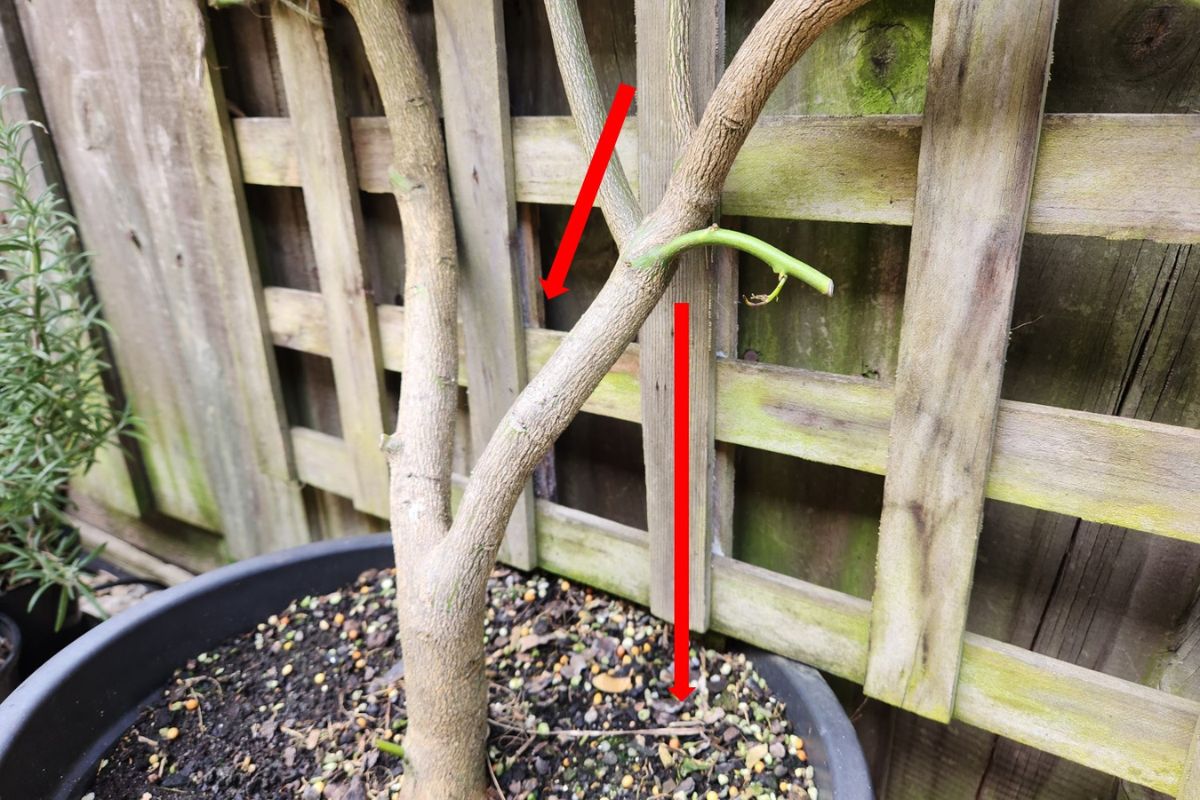 Anchor struts at the back extend into the pot and hold the trellis firmly in place.
To anchor the trellis into its pot, I nailed two long, flat pieces of wood (salvaged from another broken panel) to the back to act as struts. When pushed into the soil, these struts reach the bottom of the pot, providing excellent stability. The bottom edge of the lattice rests firmly across the back rim of the pot so it doesn't wobble.
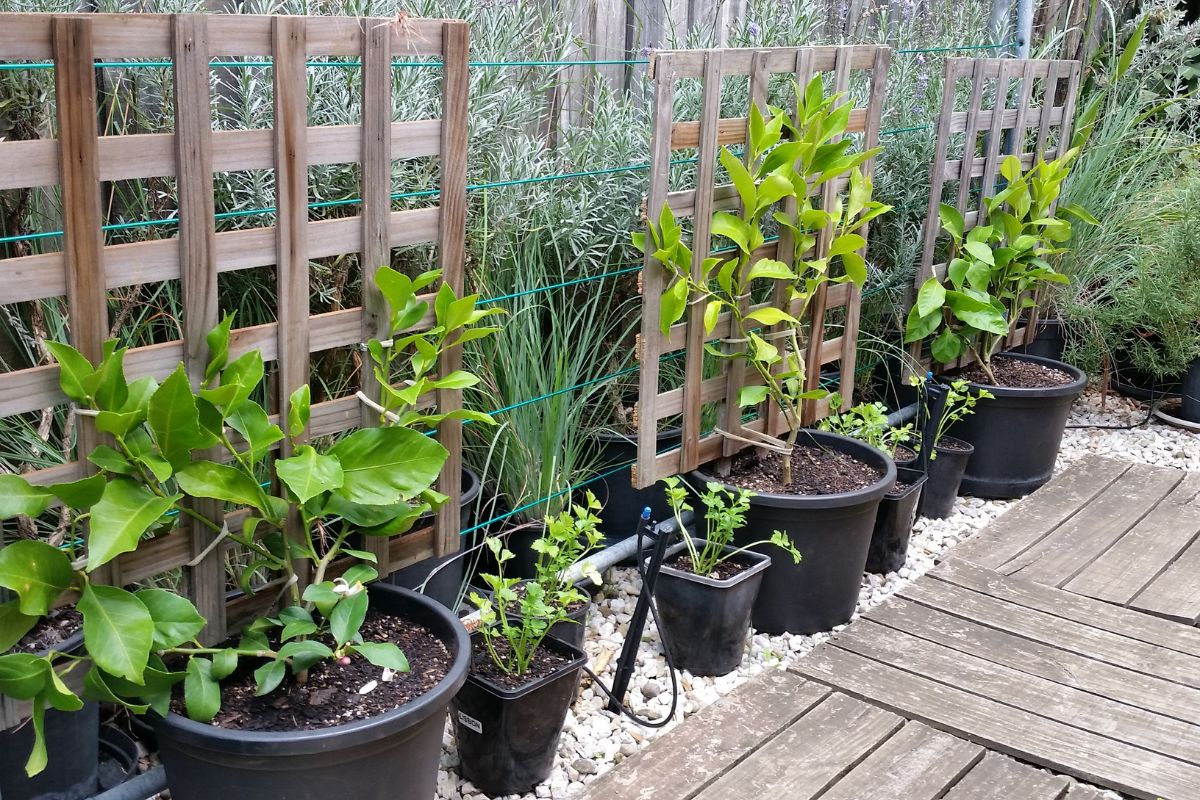 Newly potted up lemon trees (2022)
With a lattice panel pushed into the back of each pot, the flexible young branches of the lemon trees were gently bent backwards until they could be secured to the panel with soft cotton ties. Soft cotton ties work best, as they don’t cut into the young wood. It’s important not to force the branches too far backwards if it feels like they might break. Rather, only bend them back as far as they will easily go without damaging them. After a couple of weeks, they will have become used to this new position and it will then be easier to bend them back a little further and re-tie them. Over a few weeks or months, the branches gradually flatten out.
While taller lattice panels would have been nice, the panels I salvaged were perfect for this initial training phase.
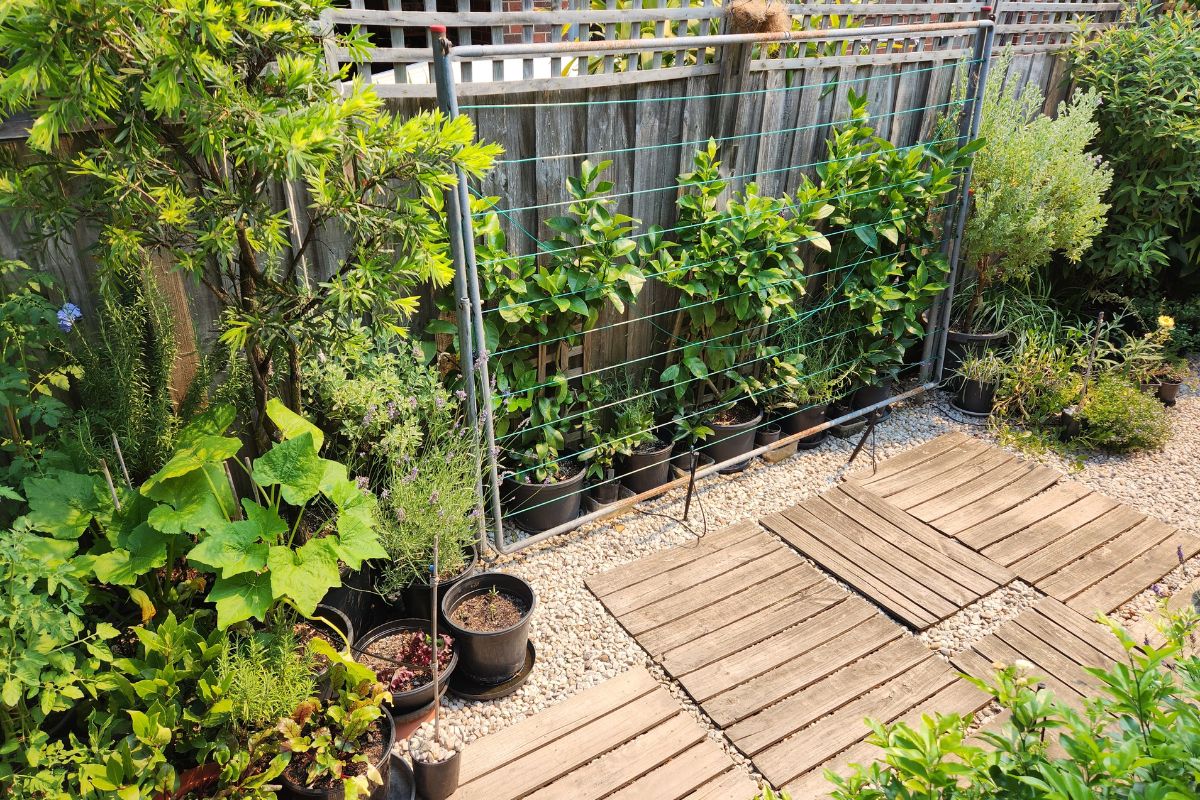 Two years later (2024) the lemon trees now extend above the lattice panel.
As the trees grew, new branches were trained to go upwards and in one plane, and when they ran out of trellis, were still encouraged to stay in a flat plane by simply running a string across the front of them to hold them back against the fence. This string also prevents them from being blown over by the wind when the washing line isn’t down.
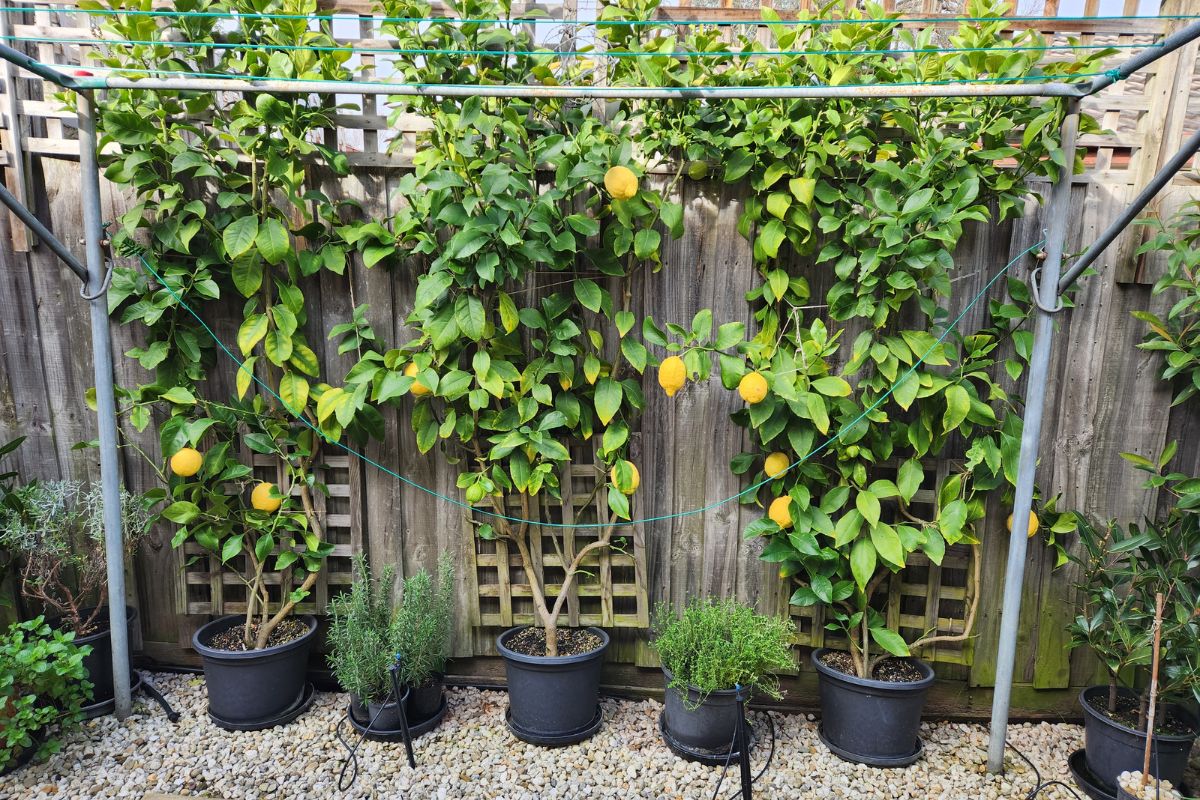 Four years later (2026) the lemon trees have grown exceptionally well and are flowering and fruiting.
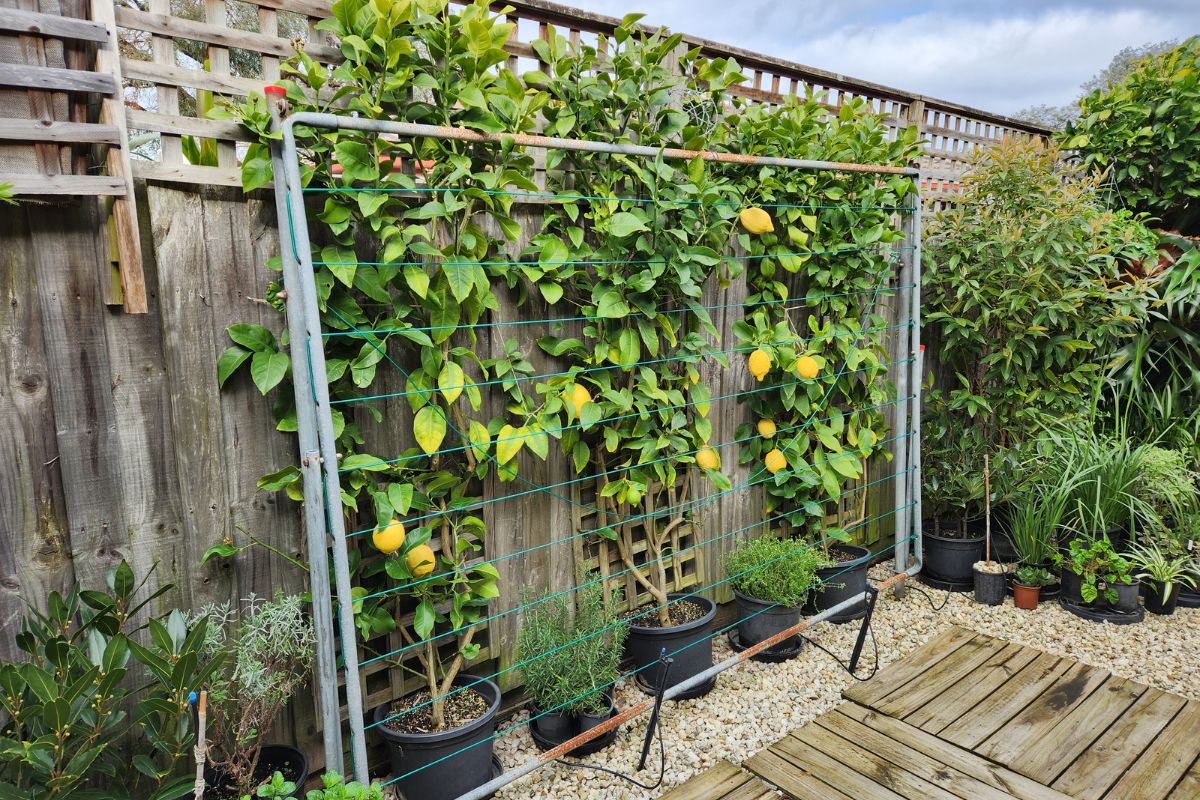 The espaliered lemon trees fit perfectly behind the washing line when the line is down and out of the way.
The gap between the washing line and the fence is only about 30cm, and the flat plane of the espaliered trees means they fit perfectly behind the washing line when it is lowered out of the way. The flat plane also means the trees don’t interfere with the washing when it is hanging out to dry.
The small lattice pieces have served their initial purpose in training the young branches to lie flat. They could be removed but as they are not needed for anything else, are not in the way, and still provide some support, they can stay.
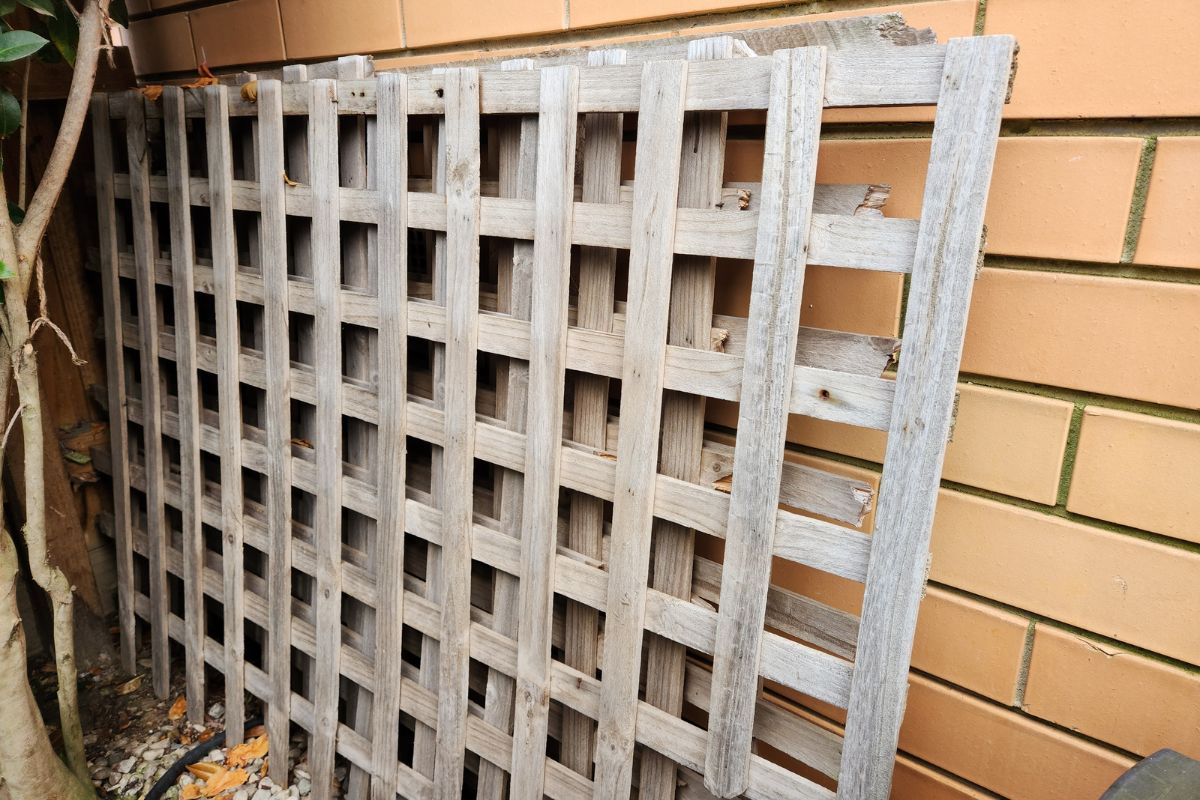 This new stack of salvaged broken lattice panelling will be useful for new projects or to repair other pieces of lattice when they break.
Caring for espaliered lemon trees in pots is the same as for any potted citrus. It’s a matter of making sure they are watered regularly so they don’t prematurely drop their flowers or fruit, and fertilising them with a slow release or liquid fertiliser.
Like all potted plants, they will use up the nutrients in the potting soil as they grow, and this needs to be replaced to keep them healthy and strong. Training the branches involves choosing which ones to keep to achieve the desired effect, and removing those that are not required. Eureka lemons tend to flower and fruit throughout the year, so sometimes flower buds had to be sacrificed in the training process.
Now that the final espalier shape has been attained, maintenance has been easy and involves occasional light trimming or pruning of branches that grow forwards, or tying them back to keep them flat, and replacing loose or broken ties.
These lemon trees are now my pride and joy. The espalier work is nowhere near as perfect or neat as if done by a professional, but the plants are looking good and doing exactly what I’d hoped they do, which is what counts. I'm thrilled to have rescued the plants, saved and recycled some perfectly serviceable lattice from going straight to landfill, managed it all on a tight budget, and most of all wowed myself by learning a new skill into the bargain!
Article & Photography by Janet Hodgkiss