
I’ve always admired the open-weave balls of rusty, barbed wire that are used as garden art. So when I was offered some wire off-cuts, I jumped at the chance to see if I could make some for myself!
However, the coil of wire I was given wasn’t aged, brown and as rusty I’d hoped. Instead, it was a slick, industrial, galvanised grey. It wasn’t quite what I had in mind, but it was free and I'd be diverting it from landfill, so I brought it home. I figured at least it would make good practice material.
A few weeks later, I decided to get started - and quickly discovered that unwinding the coil was like fending off a striking snake! Unlike rusty old wire, which has more ‘give’, this galvanised wire had an intense spring and rebound. Its barbs made excellent fangs. It wasn’t long before I retreated to dress my wounds, don some sturdier protective gear and contemplate my next move.
Even though my first attempt was a bit wonky, I was very pleased with the end result and even grew to like the grey colour. I honed my skills over the next few months, occasionally tackling and subduing my barbed wire snake until I had turned it into several smallish, barbed wire balls. I hung a few in a tree where they looked like prickly baubles, and hooked one onto the back fence while I worked out what I wanted to do with them.
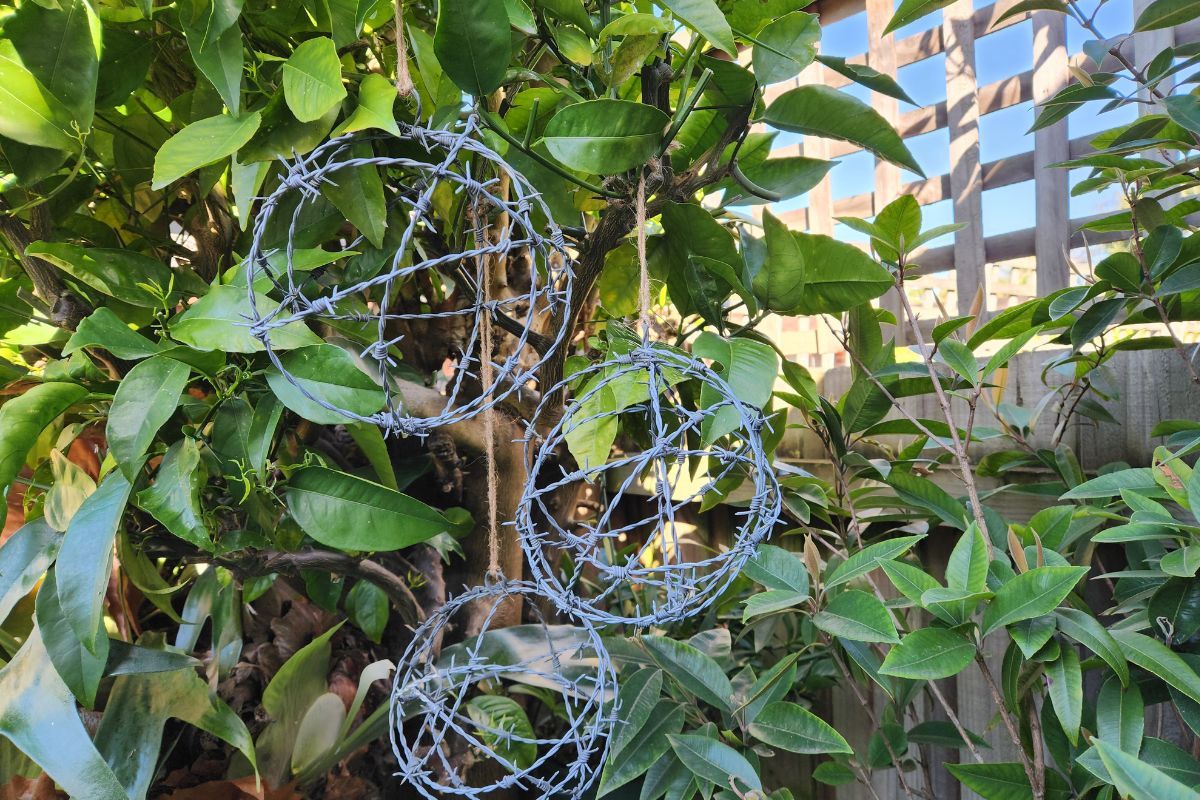 Barbed wire balls look good as tree decorations
One day, while admiring my handiwork swinging in the tree, a magpie clambered onto one of my hanging baskets and started energetically pecking at the coir lining. I thought it was digging out a bug, but soon realised it was trying to pull out pieces of the coir to use as nest material.
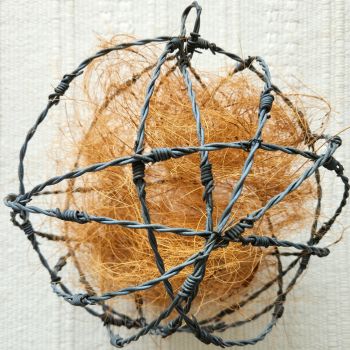
Knowing the birds would eventually destroy my hanging baskets, I needed to divert their attention with an alternative source of coir. To do this, I needed a cage of sorts to hold the material - and that’s when I realised my barbed wire balls would work perfectly.
What’s Best? Barbed Or Smooth Wire
I was a bit concerned that the barbed balls might hurt the birds, so I fashioned a new ball using plain, smooth fence wire and filled that with coir. The birds were thrilled with this new source of coir and pounced on it almost as soon as I’d hung the ball up. The coir was clean, much easier to pull out than from the hanging basket, and there was a seemingly never-ending supply of it too.
The only problem with using smooth wire was that I’d created the same open weave as when making the barbed wire balls, and because the magpies were strong, they were very adept at yanking out huge chunks of coir in one go instead of teasing it out through the weave as I thought they would. If the piece they pulled out was too clumpy for their liking, they’d simply drop it on the ground and take out another chunk until there was nothing left in the ball. They weren’t at all interested in the bits they’d dropped, so it seemed my idea of providing nest material for them wasn’t going to work.
Then I remembered that when the magpie had been pecking the matted coir liner in the hanging basket, it had only been able to grab a few strands at a time because it wasn’t coming free very easily. I thought I’d try to replicate that difficulty, but rather than make a new ball with a denser weave, I decided to use the balls with the barbs to see what would happen. Although I was still concerned the barbs might harm the birds, I know they are pretty good at negotiating plants with thorns and will use them for refuge and protection, so I reckoned they should be smart enough to negotiate the barbs on the wire. And you know what, they were! The magpies didn’t mind the barbs at all and happily poked about, selecting and teasing out the pieces they wanted, before flying off with beaks full of fluffy coir.
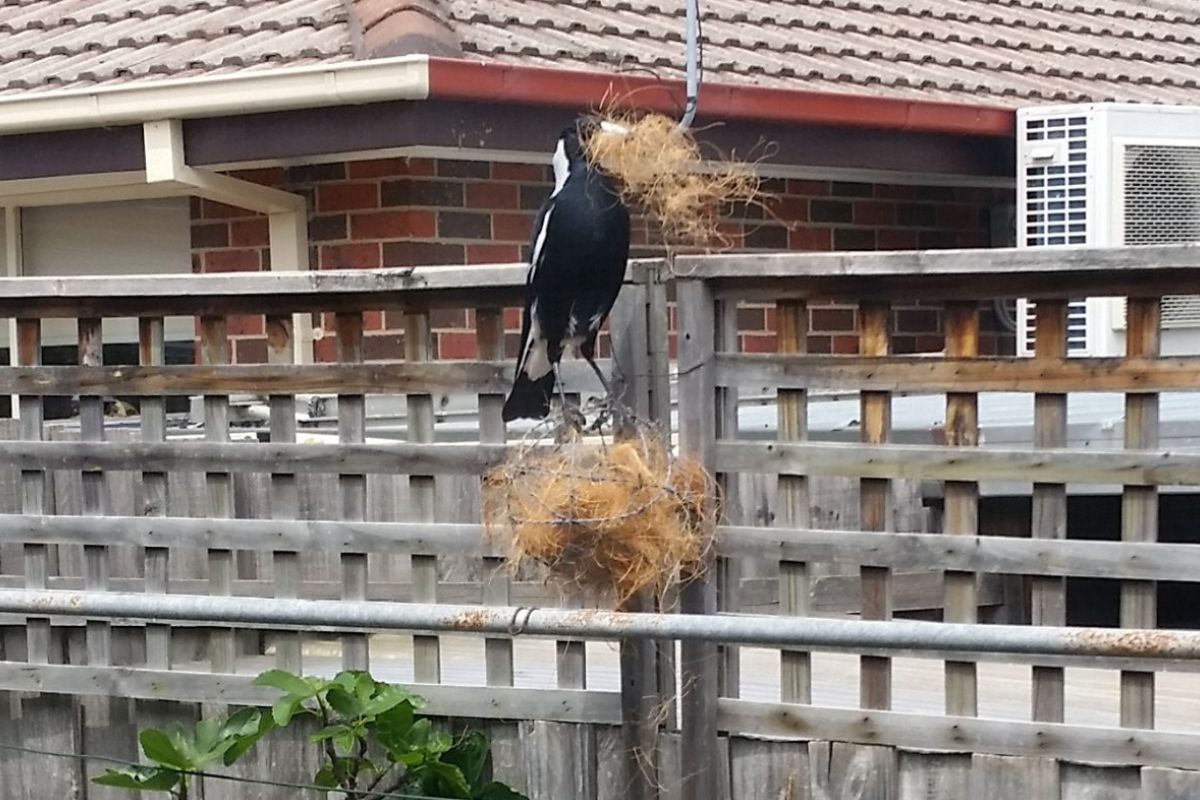 Magpie collecting coir from the barbed wire ball on the back fence.
While the magpies were not bothered by the barbs, I on the other hand was not faring so well! Even though I was careful, I was getting scratched every time I refilled the balls, so I took some pliers and flattened the barbs on some of them to make filling them a safer and more pleasant task. Enough of a ‘prickle’ still remains, once the barbs have been flattened, to hold the coir securely, so the magpies still have to tease out the coir. One of the benefits of them having to tease out the coir is that smaller strands fall to the ground which are then eagerly picked up by the local crested pigeons and smaller birds.
.jpg) Balls with flattened barbs are filled with coir for the birds, while the others remain purely decorative
Balls with flattened barbs are filled with coir for the birds, while the others remain purely decorative
Supplies And Safety
Leather gloves are non-negotiable if you use barbed wire - because getting scratched is inevitable! Riggers gloves are ideal because they are thin enough to let you feel what you are doing but strong enough to protect your skin. If the wire is rusty then this protection is even more vital (and checking that your tetanus shots are up to date is not a bad idea, either).
I used barbed fencing wire, but any sturdy wire will work. If you use smooth wire, simply make the weave denser to hold the nest material securely. If you’re recycling barbed wire, you can bend the barbs flat or cut them off before shaping. Using a thinner gauge wire to hold the main wire in place while you work also makes the job much easier.
Wire cutters make quick work of cutting sturdier wire into usable lengths, and side-cutters are ideal for cutting thinner wire. It is possible to bend the wire with your hands but pliers make gripping and bending it easier and safer, and they work well to flatten the barbs on barbed wire.
Constructing The Ball
The length of wire you will need depends on the size of ball you wish to make, and how many loops you use when forming the ball. I used 3-4m lengths which produced 15-20cm diameter balls. Aim to have enough wire to make at least five loops in different planes to form the ball. The larger the ball, the more wire and the more loops you’ll need to fill in the gaps.
Start by making a small loop at the end of the wire. This will be used to hang the ball up. Then create a larger loop as big as you’d like the finished ball to be and join it at the top where the small loop is. Depending on how flexible your wire is, you may be able to secure it with a simple twist back onto itself, but if it is more rigid and springy, then secure the main loop with a small piece of thin wire. Once the first large loop has been formed, bend the wire 90 degrees so that a second loop can be formed to create the basic ball shape. Successive loops are then wound around this basic form, securing them at intervals to keep the shape. The more loops, the denser the weave.
For extra stability and to ensure the balls hold their shape, it helps to secure the wire at the crossover points. I cut several 5-10cm lengths of a thin wire for this purpose. If you choose not to use smaller pieces of wire to secure the fence wire, then rather than simply winding the loops around the outside as you go, think like a weaver bird and weave the wire over and under as you go to make it more secure. Depending on the type and size of nest material you provide, you’ll want either an open or dense weave.
.jpg) Short pieces of thin wire are used to secure the fencing wire at crossover points
Short pieces of thin wire are used to secure the fencing wire at crossover points
Types Of Nest Material
I filled my wire balls with loose coir (coconut fibre) because that is what the birds were actively pulling out of my hanging basket. I figured they knew what they were looking for so it was easy enough to provide more of the same and stop them plundering my hanging basket.
Loose coir is readily obtainable in bags from garden centres or hardware stores. Many of the pre-moulded rigid coir basket liners are sprayed with a natural latex rubber to prevent them from falling apart too quickly in the weather. While this coating does break down over time, it means trying to use the coir from a new liner isn’t going to work because you, or the birds, won’t be able to pull the strands apart. If the birds have pecked your old hanging basket liner to shreds, then this is a good time to repot your basket using a new liner. I recycled my old hanging basket liner by allowing it to dry out completely before pulling the fibres apart and shaking off all the loose dry dirt. I put the old coir fibre into one of the balls and the birds obviously didn’t mind using the old coir because within a couple of days it was all gone.
If you want to offer other types of nest material, then stick to safe options like dry grass and straw, untreated wool, and soft, natural plant fibres. Avoid offering long human hair, or synthetic string or wool because this can wrap round chicks' legs or necks and cause injury. You can also offer small sticks, twigs and pine needles.
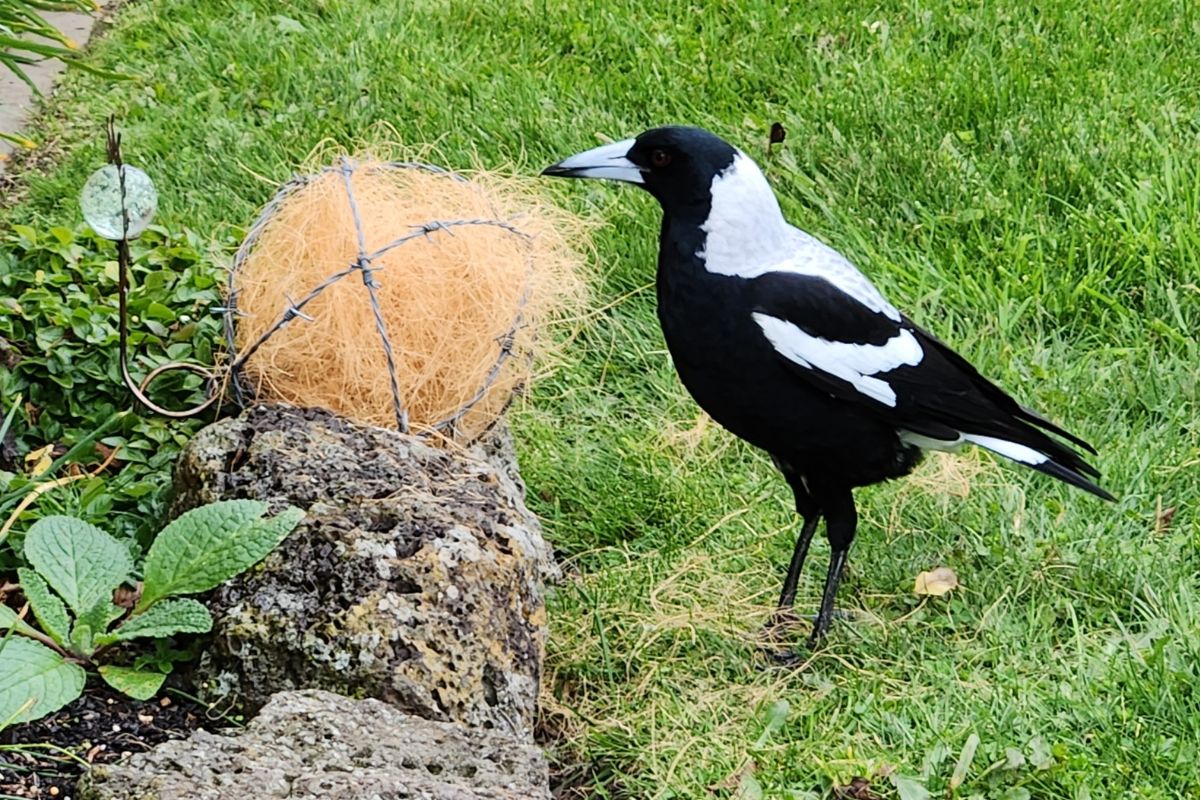 This barbed wire ball is filled with loose coir and anchored with a decorative stake
Sharing The Bounty
At the beginning of each nesting season, you may find yourself refilling the nest material balls nearly every day while the birds are actively making new nests, but it does taper off after a while. One day, while out walking, I came across a clump of fresh coir on the footpath under a tree a couple of houses down the road. I looked up and saw a few shreds of coir dangling amongst the leaves, and just above that I could see a magpie’s nest with some new coir poking over the edge of the nest.
Although I was pleased my local magpies were making use of the coir, it was disappearing at an alarming rate, and the usage wasn’t tapering off as expected. I was filling the ball I’d hung on the back fence each morning, and by the next day it’d all be gone. I didn’t think the magpies could be renovating their nest on a daily basis, so I set up a trail camera to see what other birds might be taking the coir.
When I checked the footage a few days later, I couldn’t help but laugh because it showed a ringtail possum pulling the coir out of the wire ball, rolling it down its tummy and tucking it into the curl of its tail, before dashing off along the top of the fence. They had found the ball of coir and obviously liked using it for their nests just as much as the birds!
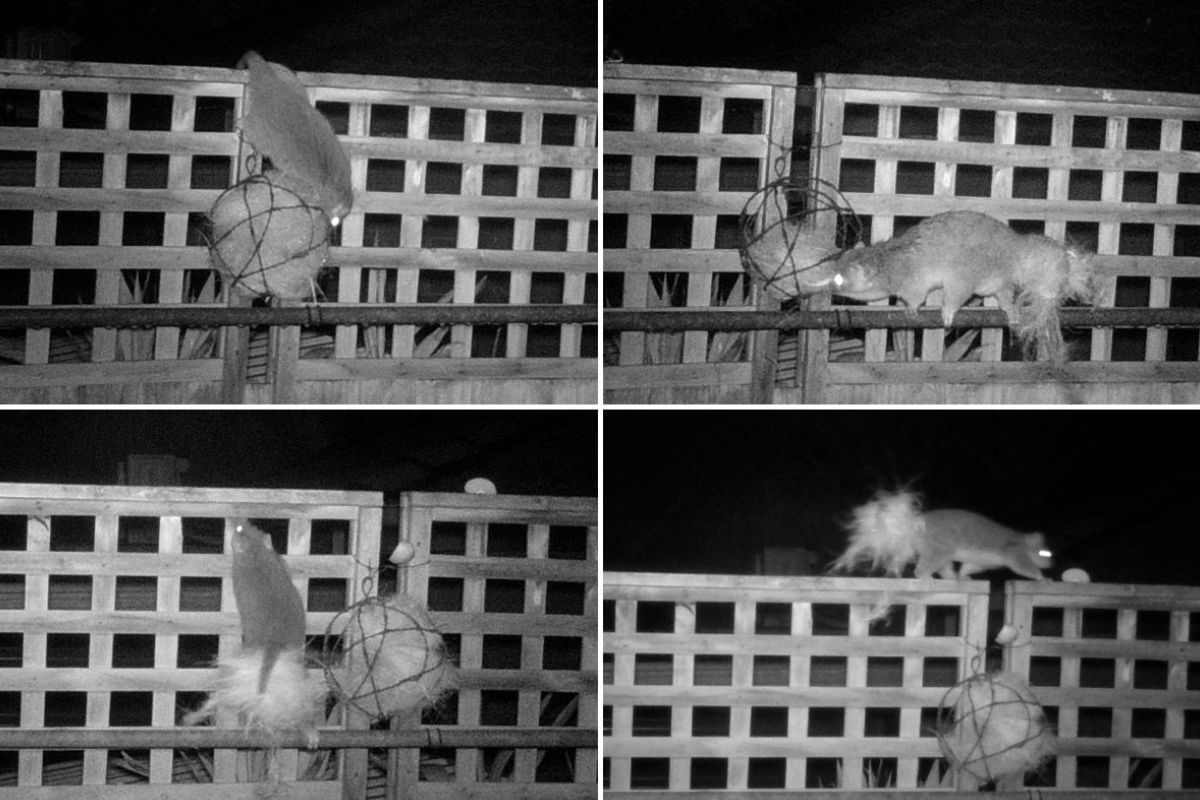 Ringtail possum collecting coir from the ball
I have since placed a ball of coir in another part of the garden where the possums don’t go, so there’s now plenty of coir for both furry and feathered friends alike.
.jpg) This coir ball at ground level is safe from possums
This coir ball at ground level is safe from possums
Article & Photographs by Janet Hodgkiss